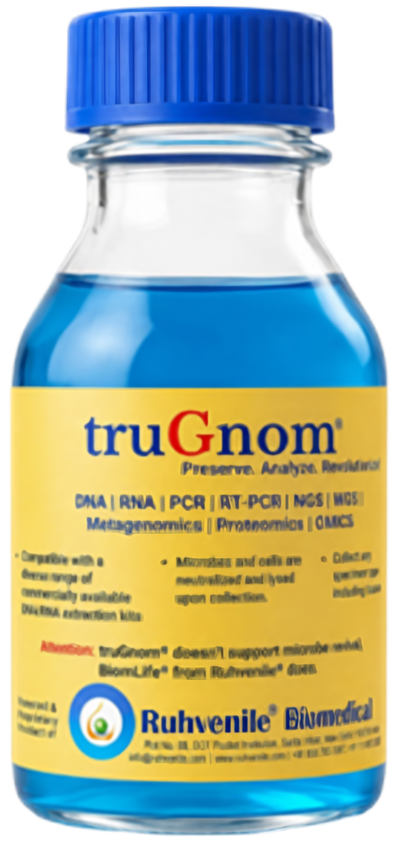
truGnom® is a patented lysis and preservation medium for every sample except blood. Cells open at collection and the DNA/RNA stay protected.
What problem does it solve?
Hard-to-lyse organisms get under-represented and nucleic acids degrade in transit. truGnom® lyses and stabilises in one step, so you go straight to extraction.
Which samples can I use it with?
Swab, sputum
Stool
Tissue, agri and animal
Environmental
Soil
All sample types except blood.
How long can I store or transport the sample?
DNA/RNA at 15–25°C3+ years
mRNA at room temperature15 days
mRNA at -80°C3–6 months
Unused medium2 years shelf life at room temperature
Which tests or workflows does it support?
NGS and metagenomics
PCR, qPCR, RT-PCR
High-throughput extraction
Molecular diagnostics
Compare the data
truGnom® or GeneLokr™? Choose in 10 seconds
How to choose in one line: pick GeneLokr™ to preserve intact cells and nucleic acids now and extract later. Pick truGnom® to lyse cells at collection and go straight to extraction. Not sure? Use the product selector.
Feature
GeneLokr™ (ambient fixative)
truGnom® (active lysis & preservation medium)
Primary mechanism
Passive preservation: locks cellular architecture and nucleic acids intact at room temperature.
Active lysis: lyses cells on contact while stabilising the released nucleic acids.
Sample state after collection
Intact cells and specimens preserved in a liquid matrix.
Lysate: cellular contents fully released and stabilised in solution.
Next step in the lab
Extract after transport (extraction is required).
Go straight to extraction (cells are already lysed).
Ideal workflow
Long-term ambient transport and storage (DNA 10–12 months, RNA 5 months at 15–25°C), or when intact structural recovery or multi-step processing is wanted.
Rapid, direct-to-extraction metagenomic and genomic workflows where immediate cell-wall and membrane disruption is critical.
Downstream focus
NGS, PCR, RT-PCR, qPCR, microarrays.
High-throughput nucleic acid isolation, metagenomic profiling and molecular diagnostics.
Sample types
Tissue, blood, invertebrates, hair and swabs from animals and humans; plant leaves, fungi, faecal samples, soil and environmental DNA (eDNA). Stabilises both DNA and RNA at ambient temperature.
All sample types except blood.
Yield with lysis reagent
Extract with your standard kit after transport.
Add a lysis reagent after collection in truGnom®: DNA and RNA yield is much higher (0.75 to 1.25X).
Quick rule
Preserve now, extract later.
Lyse now, extract later.
truGnom® or BiomLife®?
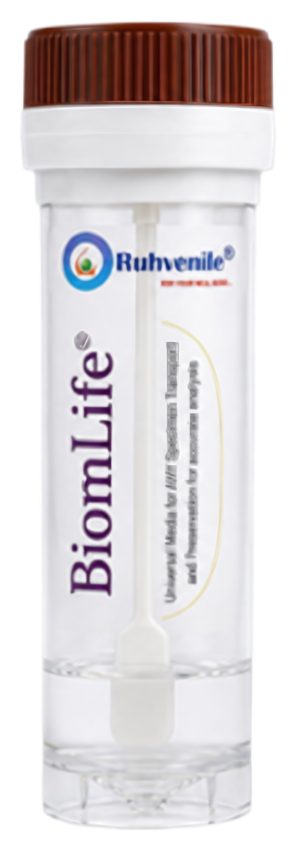
truGnom® is optimised for nucleic-acid preservation. BiomLife® preserves microbes, revives them, and also preserves nucleic acids.
Specifications
Shelf life (unused medium)
2 years at room temperature
DNA/RNA at 15–25°C
3+ years
mRNA
15 days at room temperature; 3–6 months at -80°C
Sample types
Swabs, sputum, liquid biopsy, stool, any tissue, environmental, agri and animal samples
Important
Lyses cells; does not revive microbes (use BiomLife® for revival)
Supply
Sterilised bottles; CE compliant
Catalogue codes
Code
Pack
RVN-TG-250-00
250 mL
RVN-TG-500-00
500 mL
RVN-TG-1000-00
1000 mL
RVN-TG-Bulk-00
Larger volume
How do I use it?
Add the sample to truGnom® at collection. Cells lyse on contact.
Ship at room temperature. A colour indicator flags a compromised sample.
Extract with your usual kit. No separate lysis step is needed.
Optional: add a lysis reagent after collection for a much higher DNA and RNA yield (0.75 to 1.25X).
How is it different from other Ruhvenile® and available products?
GeneLokr™: preserves intact cells, extract later. truGnom® lyses now. See the table below.
BiomLife®: revives microbes. truGnom® does not.
Taxonomic fidelity: formulated to prevent lysis bias against tough organisms.
Differences are described from product design and Ruhvenile® internal data.
FAQs
What is the difference between truGnom® and GeneLokr™?
truGnom® is an active lysis and stabilisation medium: it lyses cells on contact and stabilises the released nucleic acids for direct-to-extraction workflows. GeneLokr™ is an ambient fixative that keeps cells and nucleic acids intact for long transport and storage, then extract. Choose truGnom® to lyse now and extract later; choose GeneLokr™ to preserve now and extract later.
Can truGnom® be used for blood samples?
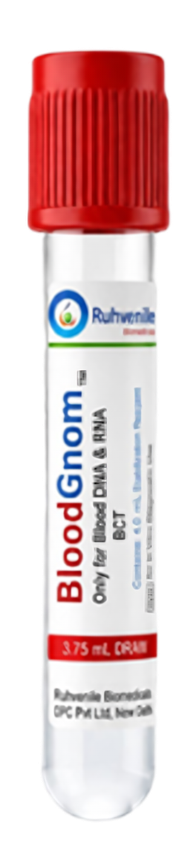
No. truGnom® suits all sample types except blood. For blood DNA and RNA use BloodGnom™, or GeneLokr™ to keep blood intact for extraction later.
Can truGnom® preserve both DNA and RNA?
Yes, it does.
Is truGnom® suitable for NGS and metagenomics?
Yes. It is formulated to prevent lysis bias, so Gram-positive bacteria and fungi are well represented in sequencing data.
Does truGnom® require a separate lysis step?
No, because it lyses cells on contact. For a much higher yield of DNA and RNA (0.75 to 1.25X), add a lysis reagent after collection in truGnom®.
Can microbes be cultured after preservation in truGnom®?
No. There is no chance of recovering microbes after collection in truGnom®. Use BiomLife® when you need live microbes.
How should truGnom®-preserved samples be transported?
At room temperature. Best practice is to keep the sample at -20°C for 24 hours before sending it at room temperature.
Can truGnom® help isolate DNA from fungi without liquid nitrogen?
Yes. With CTAB it helps isolate fungal DNA without liquid nitrogen.
What is the shelf life of truGnom® at room temperature?
2 years.
Datasheet download
PDF
truGnom® datasheet
Key features, specifications, catalogue codes, FAQs and ordering details in a 2-page PDF.