
NEW FROM RUHVENILE® R&D
GeneLokr™: Unbiased Genetic Lock for NGS, PCR, RT-PCR, qPCR and Microarrays
Absolute Genetic Lock. Uncompromised NGS & PCR Performance. No Cold Chain Needed.
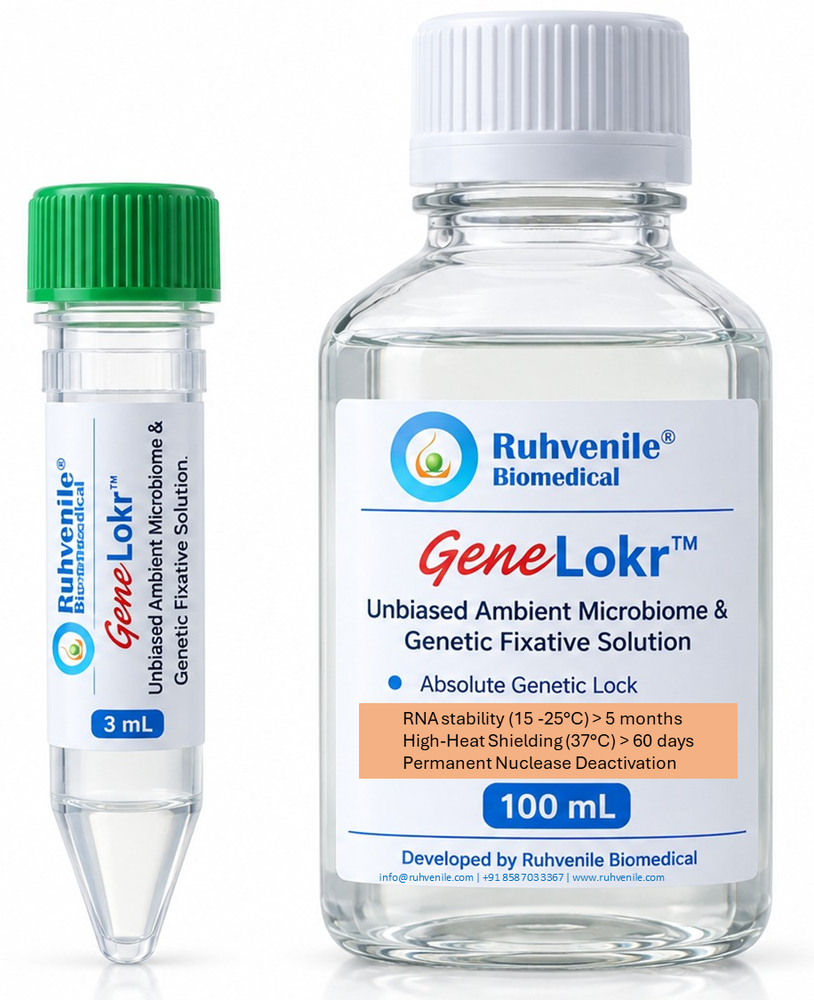
Stop risking your precious genetic samples. The cold chain is officially broken. Molecular diagnostics and genomics research are demanding, but sample preservation should not be the weak link. GeneLokr™ is an unbiased ambient fixative engineered for NGS, PCR, RT-PCR, qPCR and microarrays. It keeps cells and nucleic acids intact, locking in pristine high-molecular-weight genomic DNA and total RNA at room temperature for months, with no liquid nitrogen, no dry ice and no enzymatic inhibition. Extract whenever you are ready.
Patented and proprietary product of Ruhvenile®
Indigenous Patented Technology
Discovered and developed in India
 Made in New Delhi, India under ISO 9001:2015 quality standards
Who GeneLokr™ is for
- Molecular biology researchers who need unbiased data from NGS, PCR, RT-qPCR and microarrays
- Biobank managers who want a stable, ambient first step before ultra-cold storage
- Clinical trial coordinators running multi-centre studies with courier transit
- Oncology and diagnostic labs collecting blood, saliva, swabs and tissue biopsies
- Genomics core facility directors who need high-molecular-weight DNA and high-RIN RNA on arrival
Why legacy preservation is failing your assays
Whether you run multi-centre clinical trials, oncology panels or high-throughput transcriptomics, traditional preservation methods introduce critical failures.
- The enzymatic degradation trap: standard buffers only try to slow down degrading enzymes. A minor temperature spike during courier transit can degrade your RNA transcriptomic profile and mRNA targets before RT-qPCR.
- The downstream inhibition barrier: heavy salt fixatives often co-purify with nucleic acids and can inhibit downstream polymerases, causing PCR dropouts, failed library preps and wasted sequencing runs.
- The logistical nightmare: heavy dry shippers and liquid nitrogen tanks drain research budgets and add operational failure points.
Core unique selling propositions
Active enzymatic annihilation
Traditional buffers only try to crowd out destructive enzymes through passive salt saturation. GeneLokr™ integrates proprietary agents that act with molecular precision. They sever the critical disulfide bonds in resilient RNases and DNases, permanently destroying the enzymes that degrade samples and protecting RNA and DNA transcriptomic integrity long after collection.
Unbiased metagenomic and metatranscriptomic profiles
Stop settling for skewed datasets. GeneLokr™ gently relaxes the structural cross-links in tough cell walls without causing premature lysis in the field. When samples reach the core facility, standard extraction kits easily open hard-to-lyse organisms such as Gram-positive bacteria, spores and fungi, giving complete and accurate taxonomic representation.
Sub-saturated liquid stability and zero field precipitation
Engineered for extreme field conditions, the optimised sub-saturated formulation prevents salt crystals from forming or "crashing out" during cold-weather transits. It keeps its fluid dynamics and volumetric pipetting precision across wide temperature ranges.
Cold-chain independence and extended ambient windows
GeneLokr™ halts cellular metabolism at the moment of collection. Mixed 1:1 with high-moisture specimens, it secures samples safely at room temperature (15–25°C): RNA stays stable for 5+ months and DNA for 10–12 months, with no dry ice, ice packs or liquid nitrogen.
Key features
- Enzyme-proof: permanently inactivates RNases and DNases (irreversible).
- Inhibition-free purity: works with standard spin-column and magnetic-bead extraction kits, with no downstream enzymatic inhibition.
- Zero field precipitation: stays fluid in the cold, so 1:1 pipetting stays precise.
- Cold-chain independent: RNA 5+ months and DNA 10–12 months at 15–25°C.
- Library-ready quality: protects library complexity, reduces GC-bias and secures high DIN/RIN scores for WGS, RNA-Seq and targeted panels.
Optimised for high-sensitivity downstream workflows
- Next-generation sequencing (NGS): protects library complexity, reduces GC-bias and secures high DIN/RIN scores for WGS, RNA-Seq and targeted panels.
- PCR and RT-qPCR: eliminates trace inhibitory carryover for clean amplification curves, reproducible Ct values and reliable gene expression profiling.
- Microarrays: preserves intact transcripts and genomic integrity for high-density hybridisation and expression microarrays.
- Clinical and oncology diagnostics: secures fragile genetic material from blood, saliva, swabs and tissue biopsies without requiring immediate freezing.
Taxonomic scope and sample compatibility
Optimised for a 1:1 mixing ratio with high-moisture biological specimens, GeneLokr™ gives universal stabilisation across a vast taxonomic and environmental range.
- Microbiome and clinical samples: stool, gut microbiota, vaginal and skin swabs, saliva, blood, hair and clinical biofluids.
- Environmental metagenomics and eDNA: deep soil cores, wastewater, turbid aquatic samples, complex fungal matrices and environmental DNA.
- Diverse organisms: mammals, birds, fish, amphibians, invertebrates and insects, plants (leaves) and fungi.
How to use GeneLokr™
- Add your high-moisture sample to GeneLokr™ at a 1:1 ratio.
- Close, label and ship at 15–25°C.
- On arrival, extract straight away with your usual spin-column or magnetic-bead kit, or store at -80°C if extraction is delayed.
GeneLokr™ or truGnom®? Choose in 10 seconds
| Feature | GeneLokr™ (ambient fixative) | truGnom® (active lysis & preservation medium) |
|---|---|---|
| Primary mechanism | Passive preservation: locks cellular architecture and nucleic acids intact at room temperature. | Active lysis: lyses cells on contact while stabilising the released nucleic acids. |
| Sample state after collection | Intact cells and specimens preserved in a liquid matrix. | Lysate: cellular contents fully released and stabilised in solution. |
| Next step in the lab | Extract after transport (extraction is required). | Go straight to extraction (cells are already lysed). |
| Ideal workflow | Long-term ambient transport and storage (DNA 10–12 months, RNA 5 months at 15–25°C), or when intact structural recovery or multi-step processing is wanted. | Rapid, direct-to-extraction metagenomic and genomic workflows where immediate cell-wall and membrane disruption is critical. |
| Downstream focus | NGS, PCR, RT-PCR, qPCR, microarrays. | High-throughput nucleic acid isolation, metagenomic profiling and molecular diagnostics. |
| Sample types | Tissue, blood, invertebrates, hair and swabs from animals and humans; plant leaves, fungi, faecal samples, soil and environmental DNA (eDNA). Stabilises both DNA and RNA at ambient temperature. | All sample types except blood. |
| Quick rule | Preserve now, extract later. | Lyse now, extract immediately. |
Stability at a glance
| Condition | DNA | RNA |
|---|---|---|
| Ambient, 15–25°C | Up to 10–12 months; high-molecular-weight DNA stays suitable for PCR, restriction digests and NGS | Up to 5 months (150+ days) |
| Refrigerated, 4°C | 2–3 years | Up to 6 months |
| Frozen, -20°C to -80°C | Years (the fixative does not freeze solid) | Years |
GeneLokr™ vs NAP buffer and commercial protectors
| Feature | Standard NAP buffer | Commercial protectors (e.g. RNAlater) | GeneLokr™ |
|---|---|---|---|
| Core value | Ultra-cheap, basic DNA preservation | Reliable RNA/DNA preservation; high cost | Maximised RNA stability at a lower cost of use |
| RNase deactivation | Reversible (precipitation only) | Reversible (precipitation only) | Irreversible |
| Downstream enzymes | Salt carryover can inhibit polymerases | Salt carryover can inhibit polymerases | Engineered for inhibition-free compatibility with spin-column and magnetic-bead kits |
| Thermal robustness | Fails quickly in tropical heat (above 30°C) | Degrades over extended high heat | Protected against thermal hydrolysis |
| Handling | Severe salt crystallisation at low temperatures | Crystallises at sub-zero temperatures | No crystallisation, easy to use |
Comparison reflects Ruhvenile® internal assessment. RNAlater is a trademark of its owner and is named for comparison only.
Specifications
| RNA stability, 15–25°C | Up to 5 months (150+ days) |
|---|---|
| DNA stability, 15–25°C | Up to 10–12 months |
| 4°C | DNA 2–3 years; RNA up to 6 months |
| Frozen (-20°C to -80°C) | DNA and RNA for years; does not freeze solid |
| Nuclease deactivation | Permanent, irreversible |
| Extraction compatibility | Standard spin-column and magnetic-bead kits, with no downstream enzymatic inhibition |
| Mixing ratio | 1:1 with high-moisture specimens |
| Sample types | Tissue, blood, invertebrates, hair and swabs (animal and human); plant leaves, fungi, faecal samples, soil and environmental DNA |
| Format | Ambient fixative: preserves intact cells and nucleic acids; extract after transport |
| Downstream applications | NGS (WGS, RNA-Seq, targeted panels), PCR, RT-PCR, RT-qPCR, microarrays |
| Sequencing platforms | Illumina, PacBio, Oxford Nanopore |
| Quality assurance | Lot-specific CoA, technical data sheet and MSDS |
Catalogue codes
| Code | Pack |
|---|---|
RUV-GLR-0.9 | 0.9 mL pre-filled sterilised cryotube, pack of 50 |
RUV-GLR-1.5 | 1.5 mL pre-filled cryotube, pack of 50 |
RUV-GLR-3.0 | 3.0 mL pre-filled cryotube, pack of 50 |
RUV-GLR-100 | 100 mL bottle |
RUV-GLR-250 | 250 mL bottle |
RUV-GLR-500 | 500 mL bottle |
Trust and quality assurance
GeneLokr™ is manufactured under strict quality standards by Ruhvenile® Biomedical in New Delhi, India. Every production lot is verified for pH precision, nuclease-free material and quantitative recovery performance, and is backed by a lot-specific Certificate of Analysis (CoA), technical data sheet and MSDS.
Questions buyers ask
What is the difference between GeneLokr™ and truGnom®?
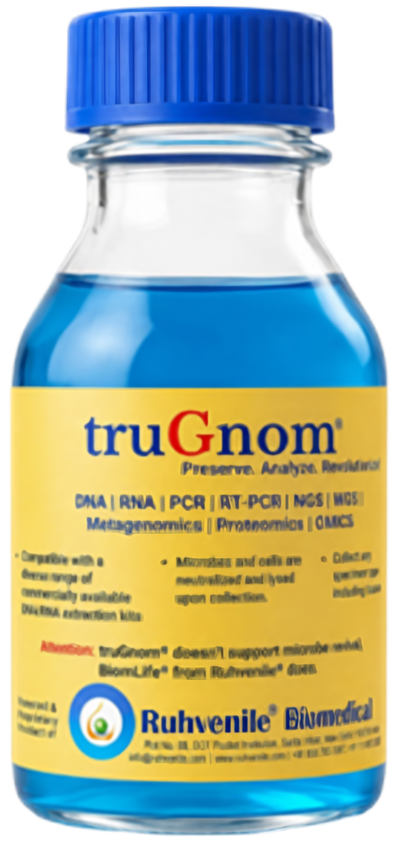
GeneLokr™ is an ambient fixative: it keeps cells and nucleic acids intact so you can transport and store them for months, then extract. truGnom® is an active lysis and stabilisation medium: it lyses cells on contact and stabilises the released nucleic acids for direct-to-extraction workflows. Choose GeneLokr™ to preserve now and extract later; choose truGnom® to lyse now and extract immediately.
Do I need to keep samples in a freezer or ice chest immediately after collection?
No. GeneLokr™ provides complete ambient stabilisation. Once mixed 1:1 with your sample, it halts cellular metabolism and locks nucleic acids, allowing safe room-temperature transport for months without dry ice or liquid nitrogen.
Will residual GeneLokr™ matrix inhibit PCR, RT-qPCR or sequencing enzymes?
No. Unlike legacy high-salt buffers that can cause polymerase inhibition, GeneLokr™ is engineered for complete compatibility with standard spin-column and magnetic-bead extraction kits, giving clean, inhibitor-free eluates.
Will GeneLokr™ cause salt crystals or precipitation in cold field weather?
No. GeneLokr™ uses an optimised, sub-saturated, highly fluid proprietary matrix designed to prevent crystal formation and keep 1:1 pipetting accurate across diverse temperatures.
What sample types and mixing ratio does GeneLokr™ use?
Mix 1:1 with high-moisture specimens: tissue, blood, invertebrates, hair and swabs from animals and humans; stool, gut microbiota, saliva and clinical biofluids; plant leaves, fungi, soil, wastewater, aquatic samples and environmental DNA.
What happens to the sample once it arrives back at the laboratory?
Samples stay secure at room temperature during courier transit: RNA remains stable for up to 5 months and DNA for 10–12 months at 15–25°C. Extract with your usual kit, or store at -80°C if extraction is delayed. GeneLokr™ does not freeze solid at -20°C or -80°C.
Which downstream applications does GeneLokr™ support?
Next-generation sequencing (WGS, RNA-Seq and targeted panels), PCR, RT-PCR, RT-qPCR and microarrays. It preserves high-molecular-weight DNA and high-RIN total RNA, and suits Illumina, PacBio and Oxford Nanopore platforms.
What quality documents come with GeneLokr™?
Each production lot is verified for pH, nuclease-free material and quantitative recovery performance, and is backed by a lot-specific Certificate of Analysis (CoA), a technical data sheet and an MSDS.
GeneLokr™ datasheet
Key features, specifications, catalogue codes, FAQs and ordering details in a 2-page PDF.
Related products
Ready to order GeneLokr™?
Tell us your sample type and volume. We reply with a quote, and can customise packs. Dispatch within 3–5 working days.